Friday, December 22, 2006

Thank You Western Victoria

Last Thursday 15 December I was officially declared to have won the fifth seat for Western Victoria. This has received considerable attention in the press as the first DLP win in the Victorian Parliament in more than fifty years .

I owe a great deal to all those people throughout Western Victoria who helped me and the DLP achieve this historic victory. I would like to thank everyone who voted for me of course. I would also like to thank everyone who thought about their vote, even if they voted for someone else.

Throughout the campaign, I was genuinely impressed by the people of Western Victoria. Strangers were noticeably friendly, warm and open. I recall teenagers on bikes calling out greetings as they rode by, drinkers at pubs putting their heads out to say hello. The people of Western Victoria really do seem to represent the best of the Australian tradition.

Throughout my campaign I argued that, as far as practicable, local people should decide local issues. I hope to get to know the ideas and views of Western Victorians better. I will visit many parts of the electorate in the new year to listen to the concerns of residents. I have also promised to pioneer new ways of consulting the people of Western Victoria. This promise will be fulfilled.

Thank you Western Victoria.

Wishing all Western Victorians the best for Christmas season and for 2007,

Peter Kavanagh
DLP MLC for Western Victoria
Parliament House, Melbourne

Sunday, November 12, 2006

Preferences Give DLP Best Chance in 50 Years

Preferences for Upper House seats were announced by the Victorian Electoral Commission at 3.48 pm today, 12 November.

The preference arrangements for Western Victoria are extraordinarily favourable to the DLP. We have the highest possible preferences from the Country Alliance and Family First and effectively, People Power. We also have high preferences from the ALP. I have only ever previously described my chances of winning as a "reasonable possibility". Under the new system of proportional representation, the preferences announced today really boosts the chances for a DLP win in Western Victoria very considerably. Now, we really do have a very strong chance of winning the seat.

I would like to sincerely thank all the other parties who have preferenced so generously to the DLP. If elected I will make myself available to listen to their concerns.

The DLP is fielding a full team of five candidates for Western Victoria. I am supported on the ticket by Clare Power of Creswick, David Power of Belmont and Michael and Leanne Casanova of Ballarat.

The DLP is fielding candidates in every Upper House seat in Victoria, so every voter will vote for or against the DLP at this election.

Tuesday, November 07, 2006

Ballarat campaign launch


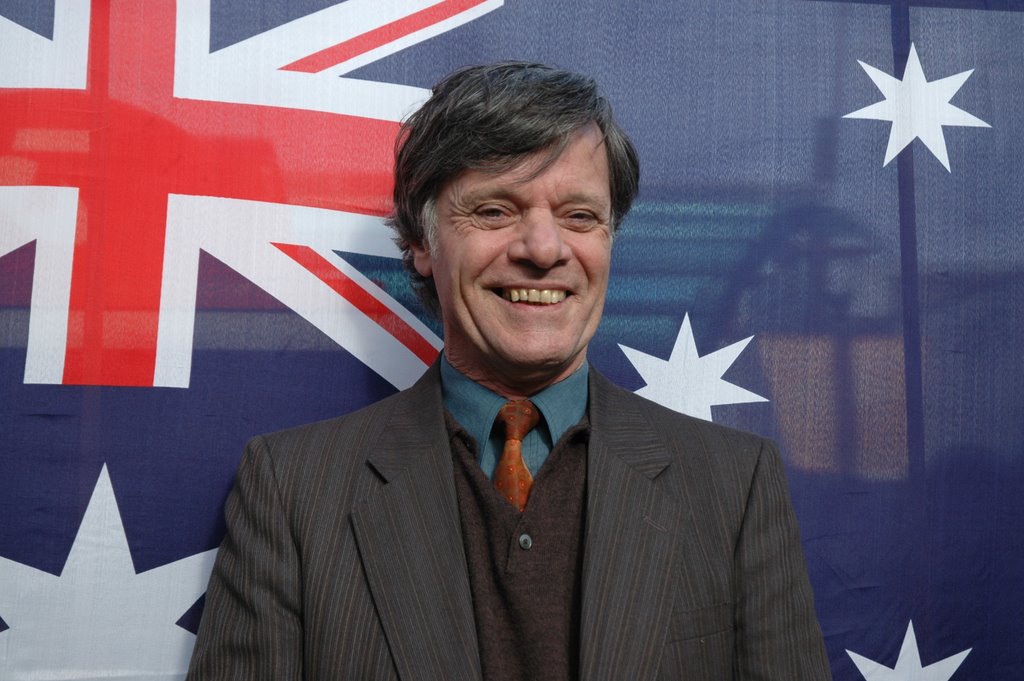
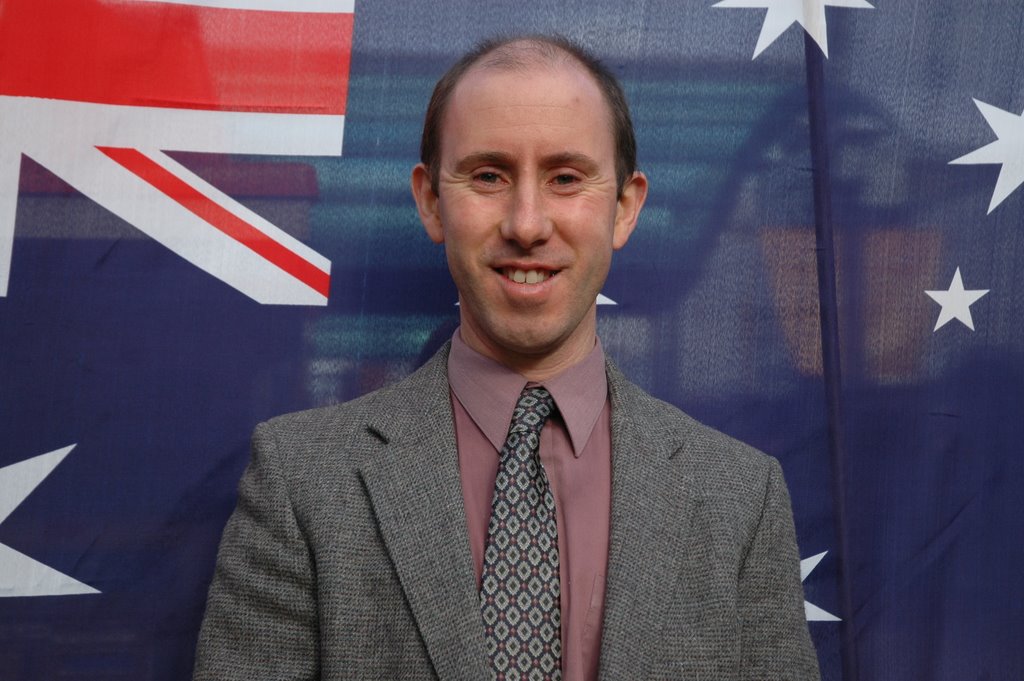
Three DLP generations... From left, Peter Kavanagh, lead DLP candidate for Western Victoria, and William Barry, son of DLP founders Bill and Mary Barry. At right is Maria Robinson, daughter of Andrew Robinson, DLP candidate for Northern Victoria.


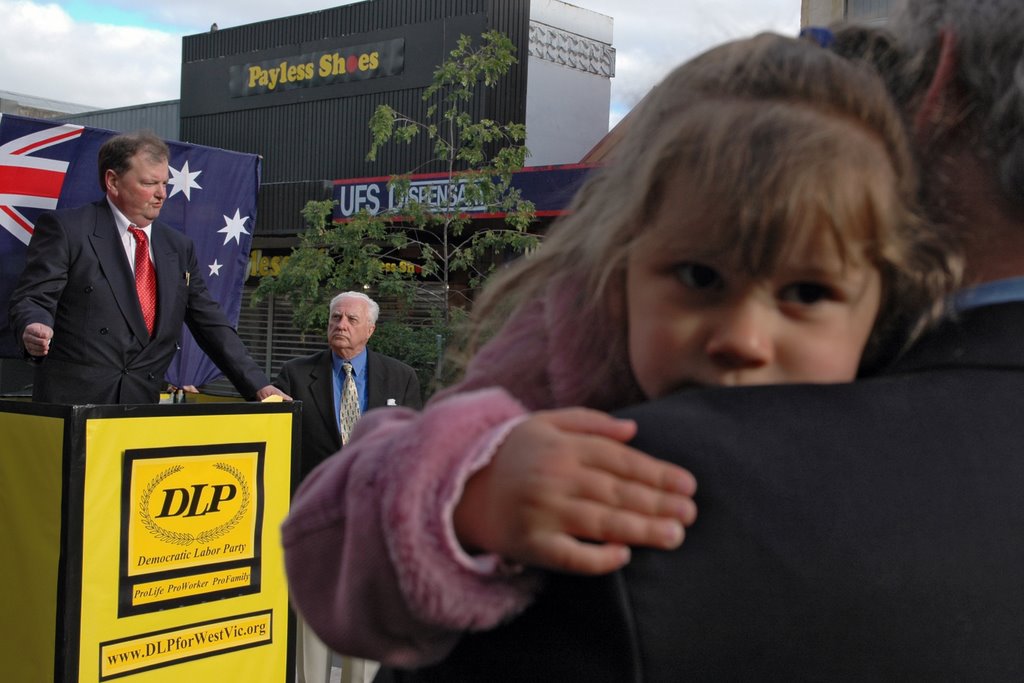
Yes, it was a bit cold and windy... but DLP candidates from around Victoria, supporters, and their children, gathered together in the Ballarat shopping mall today for the Ballarat launch of the DLP campaing in Western Victoria.

Andrew Robinson. candidate for Northern Victoria

Paul Crea, candidate for Eastern Victoria

John Mulholland, DLP Secretary

Michael Casanova, candidate for the Upper House in Western Victoria

Peter Kavanagh, candidate for the Upper House in Western Victoria, and Bill Barry (right).


Friday, November 03, 2006

Survivors of "failed" abortion need legal protection:

Victorian law should explicitly mandate medical assistance for babies born alive after "failed" abortions.

Two cases have been reported in Australia of babies being left to die following abortion procedures, including one in the Northern Territory which was the subject of a public inquest (see Aborted Girl Lived 80 Minutes, Sunday Telegraph, 14 November 1999 and The Death of Jessica Jane, Andrew Bolt, Herald Sun, 27 August 2004).

There is evidence that this happens much more frequently than it is reported. This is not so surprising, since there is no advocate for the fetus/baby in abortion procedures.

Surely babies born alive after undergoing abortion procedures are as entitled to respect and medical attention as anybody else. Members of the medical profession have a responsibility to such babies. Victorian law should make it explicit that physicians and nurses are legally obliged to do all they can to help a baby who is born alive, even after an "unsuccessful" abortion.

If I am elected to represent Western Victoria in the Upper House, I will work for legislation to mandate medical assistance for all babies born alive after 'unsuccessful' abortions. I think that many Victorians would be pleased to see both the ALP and the Liberal Party supporting this initiative.

Thursday, October 26, 2006

Education

Education is indeed, as often claimed, essential to our future prosperity and quality of life. The DLP believes that a school voucher system should be introduced. This means giving funding for their children’s education to parents. These ‘vouchers’ could be used at any registered school. This would put education funding in the hands of parents to spend as they see fit. In this way, parents would be given real choice and schools encouraged to do better. Fairness in school funding would be achieved by funding all students equally (except for those with special learning needs, who need extra amounts). The evidence in those parts of the United States where this initiative has been put into effect is that the empowerment of parents that voucher systems bring also strongly builds engagement with their children’s education and encourages schools to raise standards. Vouchers have improved education in parts of the US. While a voucher system is developed in Victoria, immediate short term steps should be taken to improve our education system.

We should recognise that the attitude of parents towards education is one of the most important factors in determining academic achievement. Parents teaching children by example that reading is a pleasure and that learning is important brings huge benefits. This is not something that government can do. It is up to members of the community.

The Victorian government should provide education that is appropriate to the interests and abilities of individual students. There is an assumption that maximising the number of students completing high school is equivalent to improving education. This thinking permeates government policy and public opinion but is misguided. The number of students completing Year Twelve has risen over recent decades. The requirements to pass have been progressively lowered to create extremely high “pass rates”. Adding large numbers of “disengaged” students to senior high classes (those who in the past would have been in technical schools or gone onto apprenticeships or other training) has not improved the academic standard of senior high school students in Victoria. Literacy standards have fallen to the point that even our best universities now feel the need to offer remedial English courses to new students.

Specialist technical education should be provided for appropriate students at school level and beyond. The ALP abolished technical schools in the late 1980s. This was a big mistake that should be reversed. It is no wonder that we are now facing a skills shortage. The Commonwealth has felt the need to partially fill the gap. Victoria should also open new technical schools. Apprenticeships should also be encouraged again on a very large scale.

The education system should help to develop good citizenship and positive attitudes. We seem to be witnessing a general reduction in character with declining abilities to postpone gratification and a growing assumption that everything is owed to the individual who has no obligations to others. There are many causes for this. The reasons seem to include biased content taught in our schools. A lot of current course content in Victoria is dedicated to inculcating a “rights mentality” in the young. While awareness of proper rights is beneficial, our education is much less eager on the whole to develop a corresponding sense of responsibility. Courses in our schools also frequently take a very critical and negative view of Australian culture, history and tradition. While there are negatives about Australia that should not be ignored, there are also positives that should be celebrated. Young people should feel happy and indeed privileged to live in Australia.

Educational standards in Victoria will rise when a voucher system is introduced. We all also need to accept responsibility as community members for encouraging positive attitudes towards education. The Victorian government needs to end the assumption that all students need or are suited to an academic education and it should encourage the development of high level practical skills for those who are suited and interested. Our education system should avoid being excessively negative and encourage the development of good citizens who have a life long love of learning.

Wednesday, October 18, 2006

The Stamp Duty Burden on Victorian First Home Buyers

The Victorian government now charges home buyers around $18,000 in stamp duty when purchasing an average house in Melbourne and close to that amount in provincial cities such as Geelong and Ballarat. What is less well known is that at the end of 2005 the state government also introduced a new "development tax" that works out to around $5,000 to $8,000 for houses in new estates. This amount is also now being passed onto new home buyers. These burdens form part of the reason why buying a home is becoming impossible for a growing number of Victorians.

The Democratic Labor Party has always placed a high priority on helping families to buy a home. Indeed, today’s help from the Commonwealth for first home buyers has evolved from earlier schemes initiated by the DLP decades ago.

In assisting a family to buy a home, governments help not only an individual but all members of a family - for life. Home ownership makes families less dependent on governments in the long term. It eliminates the need for the provision of rent assistance for example. By ending the need to pay rent, home ownership also increases resilience to economic downturns. A high rate of home ownership goes some way towards equalising the distribution of wealth. It gives all family members a sense of security and a feeling of sharing in the ownership of the country. This can only be beneficial to the long term health of our society.

Our taxation system gives huge benefits to investors (negative gearing and depreciation) but not to those struggling to buy a family home. The result is that a minority of people now own lots of properties while many families can no longer afford to buy even one.

The state government now depends on collecting huge sums in the form of stamp duty on real estate. This burden is heavy but probably manageable for those who are upgrading accommodation and have very likely benefited from capital appreciation. It is a different matter for those who are struggling to acquire a first home to simply put a secure roof over their children’s heads.

Of course it is easy for any candidate to argue against taxes. Voters are entitled to ask where the money for reducing stamp duty revenues is to come from. It would be also easy to answer that the state government should stop funding the painting of trees blue in parks for example, as it agreed to do quite recently. No doubt the expenditure on this kind of stupidity is a waste that should be stopped but it is also fairly minor in terms of total government spending. There is very serious money being misused however by the state government on advertising itself. The Bracks’ government is spending around $130 million on advertising per year, much of which is clearly intended to advantage the ALP. This expenditure should stop and the savings used to fund, among other things, cutting or eliminating stamp duty for first home buyers

If elected to represent Western Victoria in the Upper House I will propose and argue that there should be very significant stamp duty concessions for all first home buyers and that for families with children who are buying a first home, stamp duty should be entirely abolished.

Saturday, October 14, 2006

MEDIA RELEASE: Self Broadcast Campaign - Australian First for DLP

Democratic Labor Party candidate, Peter Kavanagh, appears to be the first in Australia and among the first anywhere in the world to use YouTube as a campaign and communication tool in a state or national election. Mr Kavanagh has published the YouTube videos on his campaign blog.

"The use of YouTube for the first time in a political campaign in Australia signals the opening of a new channel of communication in political debate. For decades small parties have complained they did not have the money to access media. Tools like YouTube and weblogs make getting messages across to a large audience much easier," Peter Kavanagh said.

"There is an enormous amount of political video material on YouTube, mostly relating to American politics; however, it all appears to have originally been designed for broadcast on television. It's advertising, or just snippets of television programming. There are a couple of American politicians, already elected, who have used YouTube to publish video campaign material on their websites. I don't believe any other politicians or candidates have done this in Australia yet."

"I haven't made any attempt to show-off video-making expertise, because it will be plain to everyone that I don't have any. But I should say that the videos cost the Democratic Labor Party nothing to make, and nothing to publish. That is, in itself, an interesting thing to think about."

"Major political parties in Victoria will be spending many millions of dollars on carefully crafted messages. The rest of us will just have to use our imaginations and the free media. For smaller parties, this technology provides opportunities. For major parties this technology presents dangers - their candidates will come under pressure to speak for themselves. This is precisely what the spin doctors employed by major parties do not want."

“This DLP initiative is the first small step in a process with the potential to revolutionise election campaigns throughout Australia,” Mr Kavanagh claimed.

Tuesday, October 10, 2006

Sharing Business Ownership with Workers

Australia should rapidly implement a new economic vision for the future in which workers share in the profits and ownership of businesses, an idea championed by the DLP for decades. Progress in Australia has been at a relative snail’s pace, we have now been left behind by recent implementation of this reform in Europe and the US.

Federal and state governments should provide increased tax incentives and remove obstacles to businesses sharing profits and ownership with their workers. Rewards for workers in the form of shares and dividends should also be taxed more favourably than they are at present.

Benefits would include easier capital accumulation and improved productivity and profitability for businesses and higher real wages, increased savings and long term prosperity for workers. Workers would have improved morale and concern for the profitability of the business. Profit sharing arrangements in 1990 at SPC, for example, were a major factor in saving that company. Instituted on a large scale, sharing ownership with workers will align the interests of employees and employers and greatly benefit both.

Australian manufacturing is in rapid decline due to imports. Even the agricultural sector is under strain. Measures such as selected protection and denying access to our markets to competitors who do not trade fairly are important measures that should be implemented, so should sharing the ownership of businesses with workers. Will Australia retain a manufacturing sector without the productivity and efficiency benefits that follow from sharing ownership with workers?

Successive governments in Australia have taken some very small steps. This process needs to be rapidly accelerated. I will do my best to encourage that process if elected to represent Western Victoria in the Legislative Council.

Wednesday, October 04, 2006

Flattering the DLP by Imitation?

The following is the text of a letter, part of which was published in the Herald Sun.


The Herald Sun recently published two press releases by Family First, one on the taxes on first home buyers, the other promoting the construction of dams.

Opposition to the huge tax burdens that the present state government places on first home buyers has featured on my website since late last year. Helping first home buyers has always been a primary policy of the DLP. Indeed the assistance for first home buyers that exists today evolved from initiatives of the DLP around forty years ago.

I have also strongly and clearly advocated the construction of environmentally responsible dams to avert a water crisis. This has also been prominent on my website since last December.

One of the articles concluded with a comment that has been made quite often in the Herald Sun to the effect that the introduction of proportional representation this year gives smaller parties "such as Family First" a chance of winning seats. The DLP has never been mentioned. It might therefore surprise your Herald Sun readers to know that the DLP outvoted both Family First as well as the Democrats at the last Senate election.

Peter Kavanagh

Thursday, September 28, 2006

MEDIA RELEASE: "Empower Local Communities"

Peter Kavanagh, the DLP Candidate for Western Victoria has called for a comprehensive, long term decentralisation policy based on the empowerment of local communities.

"Devolving power to the lowest level of government that can efficiently decide an issue is essential if people are to decide issues that affect them most directly. This is a long held, fundamental principle of the Democratic Labor Party," Mr Kavanagh said.

"Victoria currently lacks a comprehensive strategy for decentralisation. The ALP government's idea of encouraging industry and services around the state is merely hauled out whenever it wants to shore up support in marginal seats outside Melbourne," Mr Kavanagh said.

"At the same time, decisions are being taken at a State level that should be made by the people who are actually affected by the decision - locals."

"In Victoria at present the opposite is happening. The State government is vetoing developments against the wishes of local communities and allowing developments which are opposed by a majority of local people. Two examples happened in Geelong recently. Less than a year ago, sexually explicit entertainment at the 'Alley Cat Gentlemen's Club', a strip club, was approved by VCAT against the objections of the Geelong Council and large numbers of Geelong residents who were concerned, among other things, about the effects of this venue on local school children. Similar developments have been allowed in other parts of Victoria despite the objections of local people."

"In the middle of this year the State government vetoed the development of a Direct Factory Outlet in Greater Geelong, 'surprising the Town Hall'. This disappointed many Geelong people. Whether or not the development should have gone ahead is not the point. The point is that this is properly a matter for the people of Geelong, not the State government," Mr Kavanagh said.

"Moving the TAC to Geelong shows that the present State government's idea of decentralisation is to spend huge amounts of taxpayer's money in marginal seats with no improvement to services. This is not real decentralisation. The DLP was a prime mover behind the effective decentralisation plans of previous decades. A return of the DLP to Parliament, which is possible with the introduction of proportional representation this year, would see genuine decentralisation policy back on state and national agendas."

"Australia needs long term, coherent decentralisation strategies based on efficiently directing the future growth of government departments outside capital cities, providing government services to regional areas together with tax incentives and the recreation of a government sponsored development bank to encourage population and economic growth outside our large cities. Just as important, we also need to empower local communities to decide local issues for themselves," Mr Kavanagh said.

FOR FUTHER COMMENT CONTACT PETER KAVANAGH ON TELEPHONE m. 0413 847 413